
Kelly Fleetwood
Principal statistician at Quantics Consulting Ltd
Author of: What is indirect comparison?
Kelly leads Quantics’ meta-analysis and network meta-analysis projects. She has provided statistical support for many network meta-analyses, including therapy areas such as epilepsy, breast cancer, eye disease and weight loss. She has also presented courses on network meta-analysis in conjunction with YHEC. Kelly has an MSc is Statistics from the University of Sheffield and a BSc in Mathematics from the University of Queensland, Australia.
Summary: What is indirect comparison?
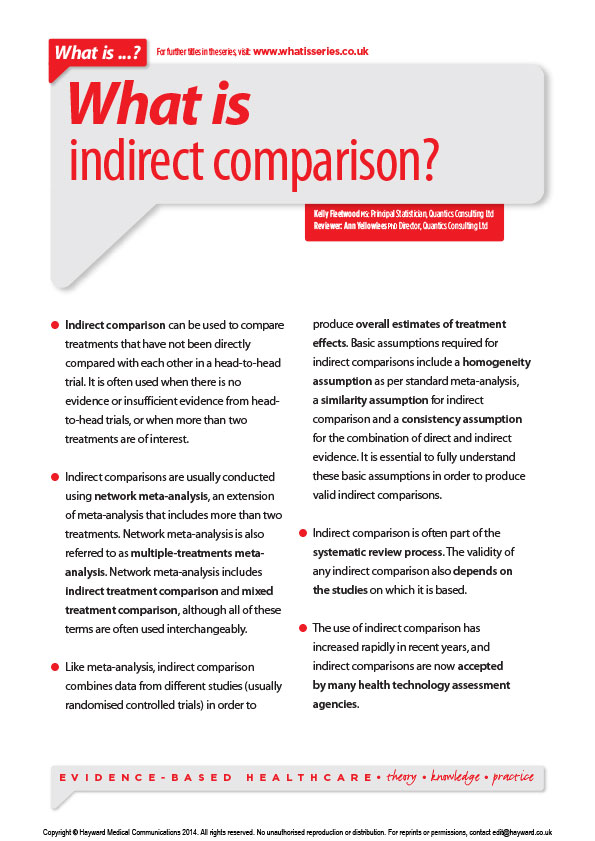
- Indirect comparison can be used to compare treatments that have not been directly compared with each other in a head-to-head trial. It is often used when there is no evidence or insufficient evidence from head to-head trials, or when more than two treatments are of interest.
- Indirect comparisons are usually conducted using network meta-analysis, an extension of meta-analysis that includes more than two treatments. Network meta-analysis is also referred to as multiple-treatments meta-analysis.
- Network meta-analysis includes indirect treatment comparison and mixed treatment comparison, although these terms are often used interchangeably.
- Like meta-analysis, indirect comparison combines data from different studies (usually randomised controlled trials) in order to produce overall estimates of treatment effects. Basic assumptions required for indirect comparisons include a homogeneity assumption as per standard meta-analysis, a similarity assumption for indirect comparison and a consistency assumption for the combination of direct and indirect evidence. It is essential to fully understand these basic assumptions in order to produce valid indirect comparisons.
- Indirect comparison is often part of the systematic review process. The validity of any indirect comparison also depends on the studies on which it is based.
- The use of indirect comparison has increased rapidly in recent years, and indirect comparisons are now accepted by many health technology assessment agencies.

